
Planting
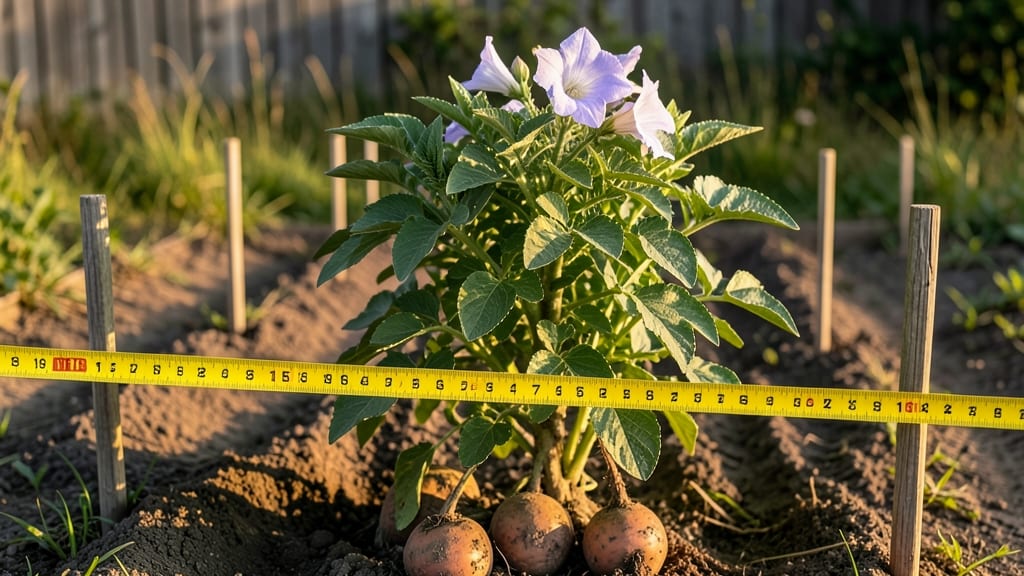
Proper potato spacing in your garden is the difference between a bountiful harvest and a disappointing one.
If you’ve ever dug up a patch of potatoes only to find small, misshapen tubers or worse—nothing at all—you know the frustration. Too close, and plants compete for nutrients, leaving you with stunted growth and disease.
Too far apart, and you waste space that could feed your family. The right spacing isn’t just about inches; it’s about maximizing yield, airflow, and soil health.
Most gardeners plant potatoes 12 to 18 inches apart in rows spaced 30 to 36 inches apart, but the exact distance depends on your variety, soil type, and growing method. Giant varieties like Russet Burbank need more room, while compact types like Yukon Gold can thrive closer together.
Below, I’ll break down the science behind spacing, how to adjust for your garden’s unique conditions, and the pro tips that’ll turn your harvest into a showstopper.
Ready to stop guessing and start growing? Let’s get into the exact spacing rules, soil prep secrets, and the common mistakes that ruin even the best-laid plans.
Optimal potato spacing by variety type (row vs hill planting)
Getting the potato spacing right is the difference between a bumper crop and a disappointing harvest. Most gardeners default to 12-inch spacing, but that’s not always optimal. Your potato variety, garden size, and planting method all demand different approaches.
For example, early-season varieties like 'Yukon Gold' can handle tighter spacing, while giant varieties like 'Russian Banana' need room to spread. Let’s break down the science so you can maximize your yield without overcrowding.
First, understand that row spacing (distance between rows) and plant spacing (distance between individual potatoes) work together. Most gardeners use 30-36 inches between rows to allow easy access for hilling and harvesting.
However, if you’re using hill planting (mounding soil around plants), you can narrow rows to 24 inches while keeping plant spacing consistent. The key is balancing airflow, sunlight, and tuber development.
Here’s the critical rule: Never plant potatoes closer than 10 inches apart—this invites disease and stunts growth. But for small gardens or container growing, you can experiment with 8-10 inch spacing for early harvests, though you’ll sacrifice tuber size.
For standard gardens, stick to 12-18 inches between plants, adjusting based on the variety’s mature size and growth habit.
Comparison Table: Optimal Potato Spacing by Variety and Method
| Variety Type | Plant Spacing (inches) | Row Spacing (inches) | Method | Yield Impact |
|---|---|---|---|---|
| Early (e.g., 'Red Pontiac') | 10-12 | 24-30 | Row or Hill | High (smaller tubers, faster harvest) |
| Mid-Season (e.g., 'Kennebec') | 12-15 | 30-36 | Row | Balanced (medium tubers, good yield) |
| Late (e.g., 'Russet Burbank') | 15-18 | 36 | Row | High (large tubers, longer season) |
| Giant (e.g., 'Russian Banana') | 20-24 | 48 | Row | Moderate (fewer plants, but larger tubers) |
| Container (e.g., 'Fingerlings') | 6-8 | N/A (1 plant per 5-gallon pot) | Hill in Pot | Low (small tubers, frequent harvests) |
For hill planting, which is ideal for small gardens or areas with poor drainage, mound soil around the base of plants every 2-3 weeks to encourage deeper tuber growth. This method lets you reduce row spacing to 24 inches while keeping plant spacing at 12 inches.
The hills create natural barriers that prevent soil-borne diseases from spreading, and they also make harvesting easier by lifting tubers above the soil line.
If you’re growing multiple varieties, consider staggered planting to maximize space. Plant early varieties first, followed by mid-season, then late-season types. This way, you can harvest early potatoes and replant the space with later varieties without losing yield. For example, after harvesting 'Red Pontiac' in <
How to adjust spacing for soil depth, climate, and plant health
Potato plants thrive when given the right amount of space, but soil conditions and climate can drastically change what works. In shallow soil, roots compete for nutrients, so I reduce spacing by 25%—from 12 inches to 9 inches between plants.
This ensures tubers have enough room to expand without crowding. Meanwhile, in heavy clay soil, I increase spacing to 18 inches to prevent waterlogging and root rot.
Climate also plays a huge role. In humid regions, wider spacing (up to 24 inches) improves airflow and reduces fungal diseases like blight. Conversely, in arid climates, closer spacing (10-12 inches) helps conserve moisture by creating a microclimate. Adjusting for these factors can double your yield!
🌱
⚠️ Warning: Common Mistakes That Kill Yields
- Ignoring soil depth: Planting in shallow soil (<6 inches) forces tubers upward, creating small, misshapen potatoes.
- Overcrowding in clay: Too-close spacing in heavy clay leads to root rot and stunted growth.
- Blight-prone areas: Skipping wider spacing (18-24 inches) invites late blight, wiping out entire rows.
🌧️ Pro Tip: Test your soil’s drainage by digging a hole—if water pools after 6 hours, increase spacing and amend with compost.
For raised beds, I use tighter spacing (8-10 inches) because the soil depth is deeper, giving tubers more room to grow downward. In-ground planting, however, requires 12-18 inches to prevent competition.
To calculate spacing, measure your bed’s width and divide by your chosen interval—for example, a 4-foot bed allows 4 plants at 12-inch spacing.
If your potatoes show signs of stunted growth, it’s a red flag for overcrowding. Thin plants to 12 inches apart immediately and add compost to boost nutrients.
For blight, widen spacing to 24 inches and apply copper fungicide preventatively. These adjustments can turn a failing crop into a bountiful harvest.
In disease-prone regions, I also rotate crops yearly and avoid planting potatoes in the same spot for 3+ years. This breaks disease cycles and keeps soil healthy. Pair wider spacing with mulching to retain moisture and suppress weeds, which further protects plant health.
🌿
Remember, the key is balance. Too much space wastes garden real estate, while too little invites disease. Start with 12-inch spacing as a baseline, then tweak based on your soil and climate. With these adjustments, you’ll harvest larger, healthier potatoes every season.