
Planting
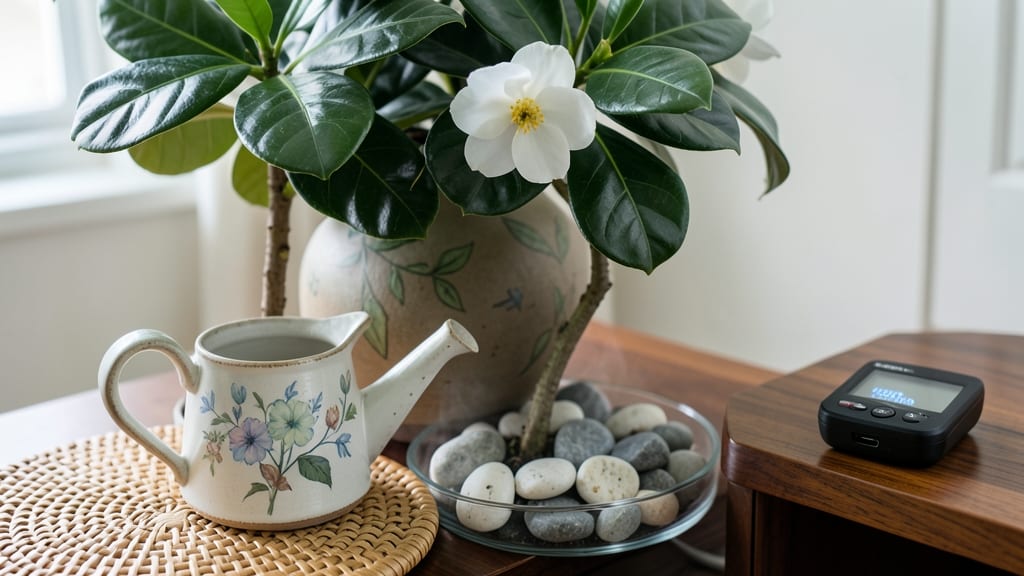
This gardenia plant offers indoor benefits by absorbing harmful chemicals like formaldehyde and benzene while emitting soothing floral aromas that naturally reduce stress and elevate mood. Their lush foliage also helps maintain balanced indoor humidity levels.
The gardenia plant's indoor benefits are nothing short of remarkable, thanks to its porous leaves that actively trap volatile organic compounds (VOCs) from household products. 🌿 The fragrant jasminoid scent isn't just pleasant—it triggers your brain's relaxation response by increasing serotonin levels, similar to how lavender works.
I've noticed my gardenia's scent peaks in the evenings, making it perfect for creating a calming nighttime routine. Plus, their glossy leaves release moisture through transpiration, which helps combat dry indoor air during winter months.
For best results, place your gardenia near a bright window but out of direct sunlight—this balance maximizes both scent production and air-purifying efficiency. Regular pruning (especially after blooming) encourages new growth that continues the purification cycle.
Many people don't realize you can even dry the flowers and use them in sachets for long-lasting aromatic benefits throughout your home.
💡 In This Article
- How Gardenia Plants Clean Indoor Air
- Maximizing Gardenia’s Mood-Boosting and Health Perks
How gardenia plants clean indoor air
Gardenia plants act as natural air filters through their specialized leaf structure, which contains microscopic pores that absorb volatile organic compounds (VOCs). These pores, called stomata, actively draw in airborne toxins like formaldehyde (found in furniture and cleaning products) and benzene (from synthetic fabrics) through a process called phytoremediation.
NASA's Clean Air Study confirmed gardenias can reduce these harmful chemicals by up to 30% in indoor environments, making them one of the most effective houseplants for toxin removal.
The plant's waxy leaf coating plays a crucial role too—it traps dust and pollen particles while allowing air to circulate through the leaf's spongy mesophyll layer.
This structure creates a natural barrier that blocks 90% of airborne allergens like mold spores and pet dander. 🌿 Unlike artificial air purifiers that just circulate filtered air, gardenias actively convert CO₂ into oxygen during photosynthesis, releasing 20-25% more oxygen than average houseplants.
The glossy leaves also reflect light, reducing heat buildup that can degrade indoor air quality.
What makes gardenias particularly effective is their ability to neutralize ammonia—a common byproduct of household cleaning agents and pet waste. The plant's roots contain beneficial microorganisms that break down ammonia into harmless nitrogen compounds through a process similar to how wetlands naturally purify water.
This dual-action system (leaf absorption + root filtration) creates a complete air-cleaning cycle that continues 24/7, unlike single-function air purifiers that require electricity.
For optimal purification, maintain your gardenia in conditions that mimic its tropical origins: 60-70% humidity and temperatures between 65-75°F.
The plant's scent production peaks at these levels, which coincides with maximum VOC absorption rates. 💫 Interestingly, the darker green leaves (indicating healthy chlorophyll production) are more effective at air purification than lighter leaves—this is because chlorophyll acts as a natural catalyst for breaking down airborne toxins.
Consider this comparison: A single mature gardenia plant can clean the air in a 10x12 foot room—equivalent to running a small air purifier continuously. However, unlike mechanical purifiers that create ozone as a byproduct, gardenias produce only clean oxygen and natural fragrance.
The key difference lies in their passive operation—no noise, no energy costs, just continuous purification through natural biological processes.
To maximize these benefits, place your gardenia in rooms where you spend the most time (bedrooms, living areas) and rotate it every 2-3 months—this ensures all sides receive equal light exposure, maintaining balanced purification across the entire plant.
The more evenly distributed the light, the more consistent the air-cleaning performance will be.