
Tools
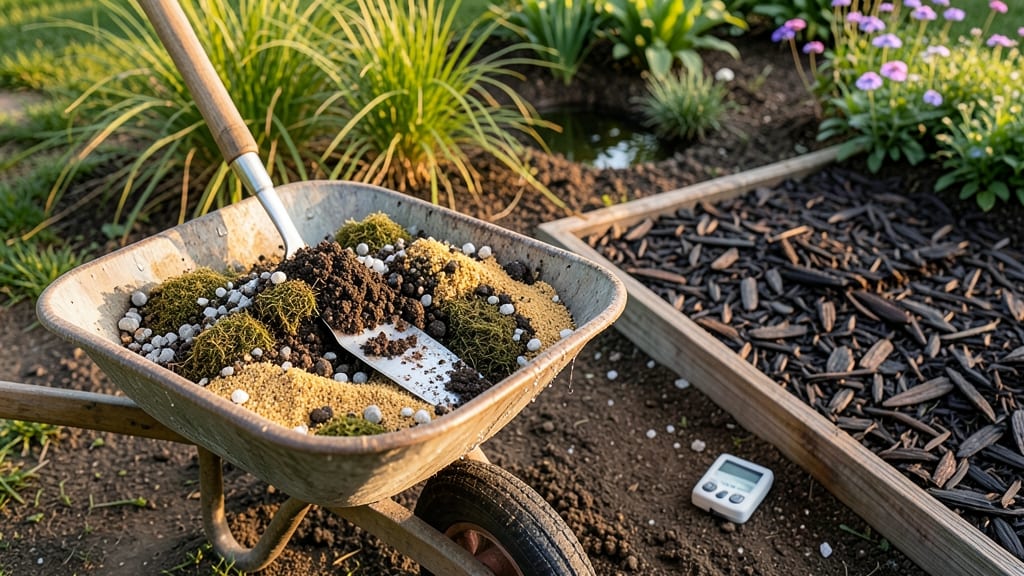
A rain garden soil mix should blend 30% native topsoil, 30% compost, 20% coarse sand, and 20% perlite or peat moss to balance drainage and moisture retention for plants like asters and coneflowers.
A rain garden's success depends on this mix's ability to handle fluctuating water levels.
The compost and native topsoil provide essential nutrients while the coarse sand and perlite create air pockets that prevent waterlogging. 🌱 This combination mimics natural wetland conditions, which is why it works so well for moisture-loving perennials.
For clay-heavy areas, you might increase the sand ratio to 30% to improve drainage further.
When mixing, spread the compost and topsoil first, then incorporate the sand and perlite evenly. This layering helps create the ideal texture from the bottom up. The key is achieving a crumbly, almost sandy-loam consistency that holds water but doesn't stay soggy.
For large gardens, consider renting a rototiller to blend everything uniformly.
💡 In This Article
- Why Soil Composition Matters in Rain Gardens
- DIY Rain Garden Soil Blend Recipes by Plant Type
Why soil composition matters in rain gardens
Rain gardens thrive because their soil blend is specifically engineered to handle two opposing forces: water retention and drainage. The 30% compost in the mix acts as a moisture sponge, absorbing water during heavy rains while gradually releasing it to plant roots.
This organic matter also introduces beneficial microbes that break down nutrients, creating a slow-release fertilizer system. Without this compost layer, plants would struggle during dry spells, even in wet climates.
The 20% coarse sand plays a critical role by preventing compaction—a common issue in clay-heavy soils. Sand particles create air pockets that improve aeration, allowing roots to breathe while preventing water from pooling.
For comparison, fine sand (like beach sand) would compact over time, but coarse sand (with particles 1-2mm in diameter) maintains structure. This is why construction sites use similar sand ratios for drainage systems—it's all about particle size and spacing.
Perlite or peat moss (20%) adds another layer of functionality. Perlite expands when heated, creating lightweight, porous granules that hold 3-5 times their weight in water. This is particularly valuable in areas with heavy rainfall, as it prevents erosion while ensuring excess water drains downward.
Peat moss, on the other hand, holds moisture longer and is better suited for drier-edge rain garden plants like black-eyed Susans. The choice between these two depends on your local climate and plant selection.
Here's what happens when you get the balance wrong: Too much sand (30%) creates a "flashy" soil that drains too quickly, causing plants to dry out. Too much compost (40%) leads to compaction and anaerobic conditions, where roots suffocate from lack of oxygen.
The 30-30-20-20 ratio strikes the perfect equilibrium, much like how wetland ecosystems naturally regulate water flow through layered organic and mineral deposits.
For visual learners, imagine a slice of rain garden soil under a microscope: the compost forms a web-like structure that traps water, while the sand and perlite create a lattice of air channels.
This dual-system is why rain gardens can support both water-loving plants (like cardinal flowers) and moderately drought-tolerant species (like bee balm) in the same space. The science here mirrors how nature designs floodplains—layered, porous, and self-regulating.
One pro tip: If your native soil is particularly dense, consider adding 10% coconut coir to the mix. Coir fibers break down slowly, adding long-term structure while improving water infiltration. This is especially useful in urban areas where compacted soil is common.
The result? A soil blend that mimics the natural resilience of wetlands, where plants have evolved to thrive in fluctuating water conditions.